
Last updated October 16, 2026
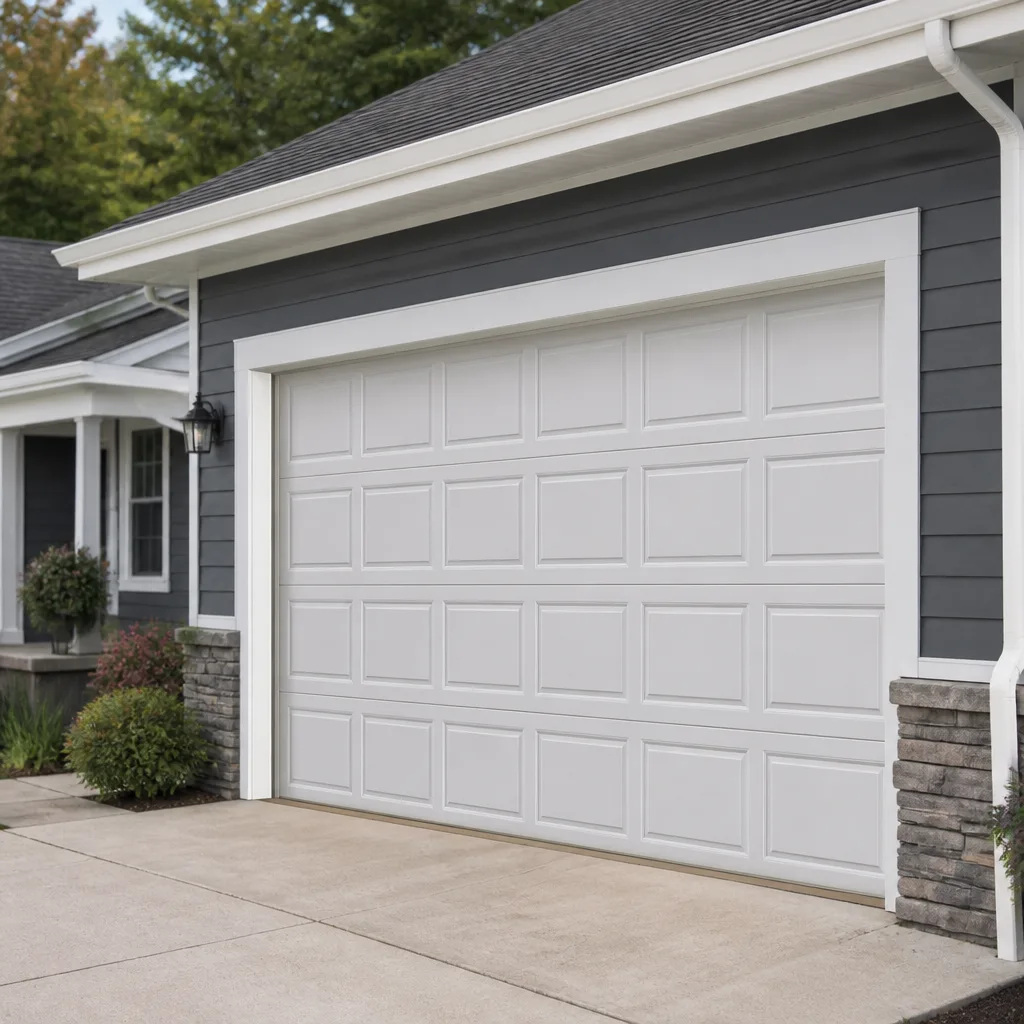 Raised-panel steel
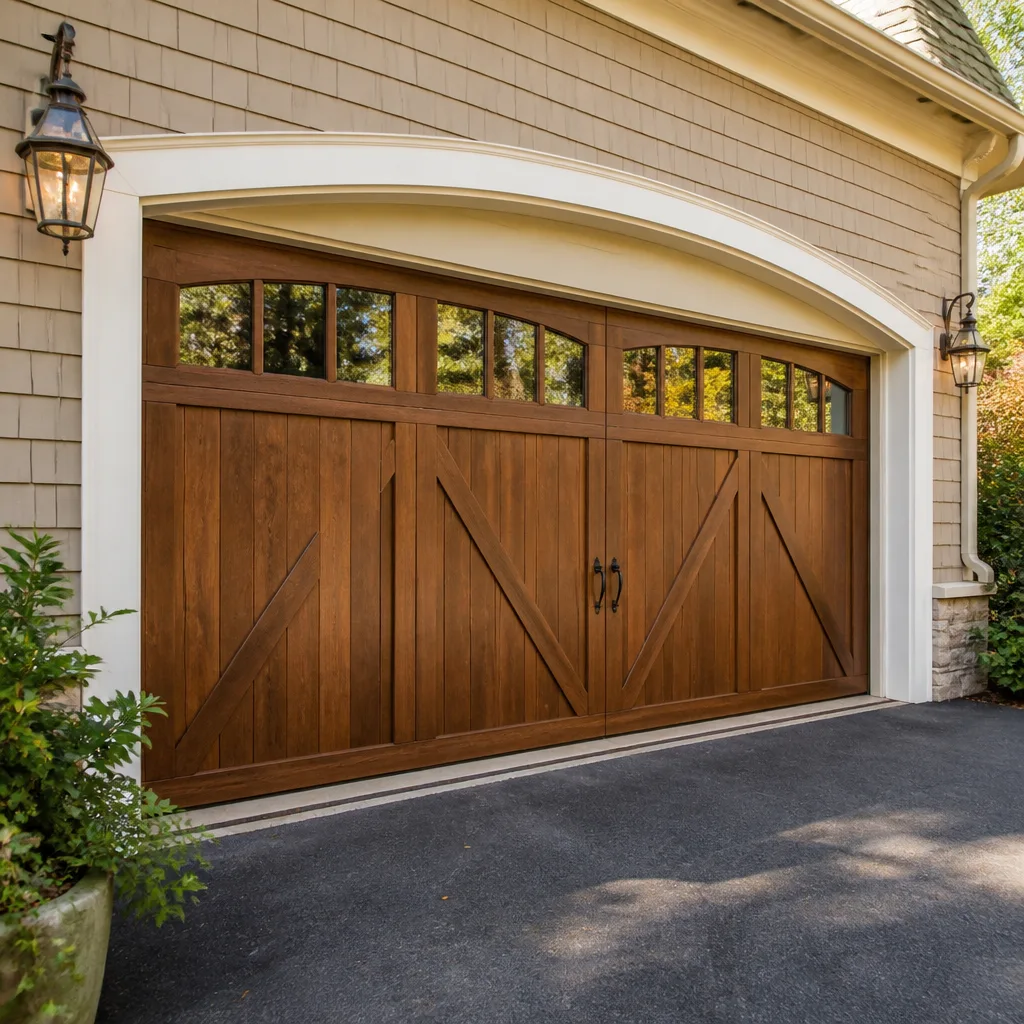 Carriage house
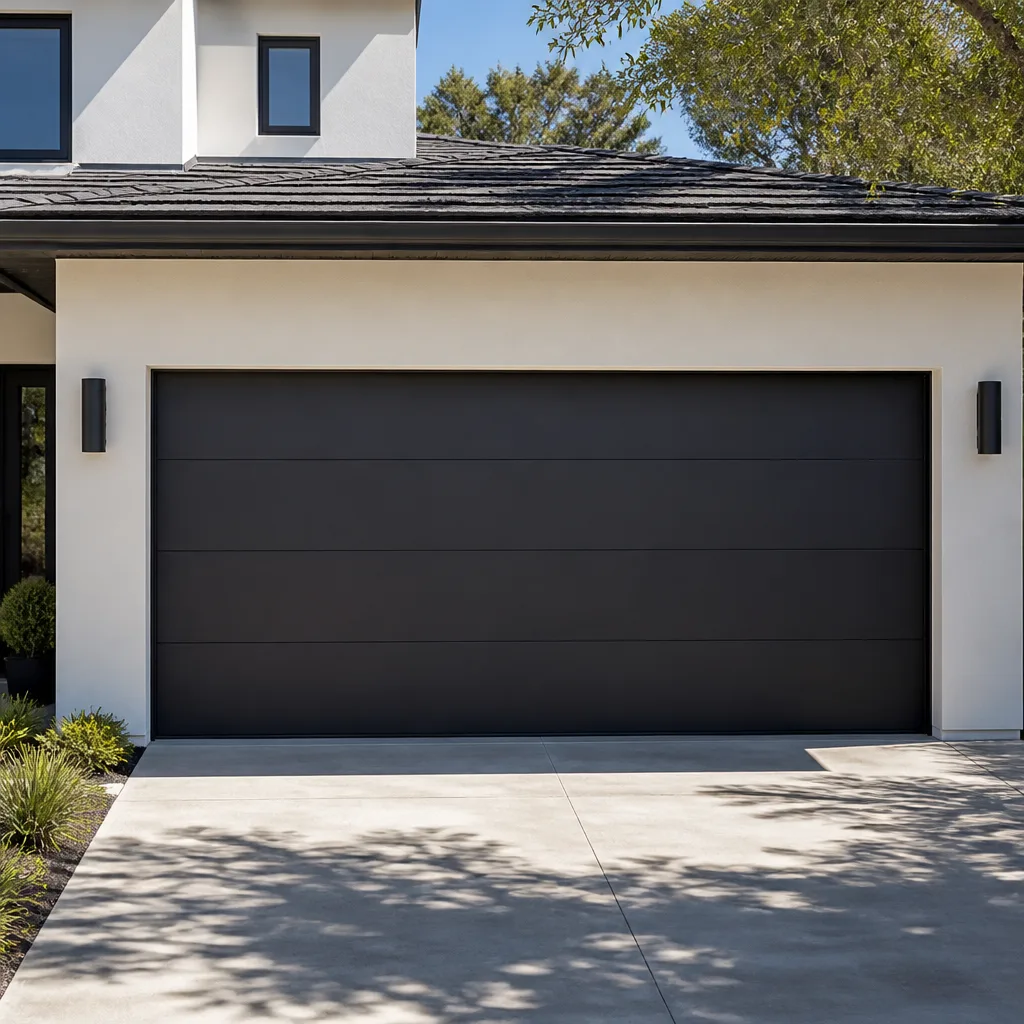 Modern flush
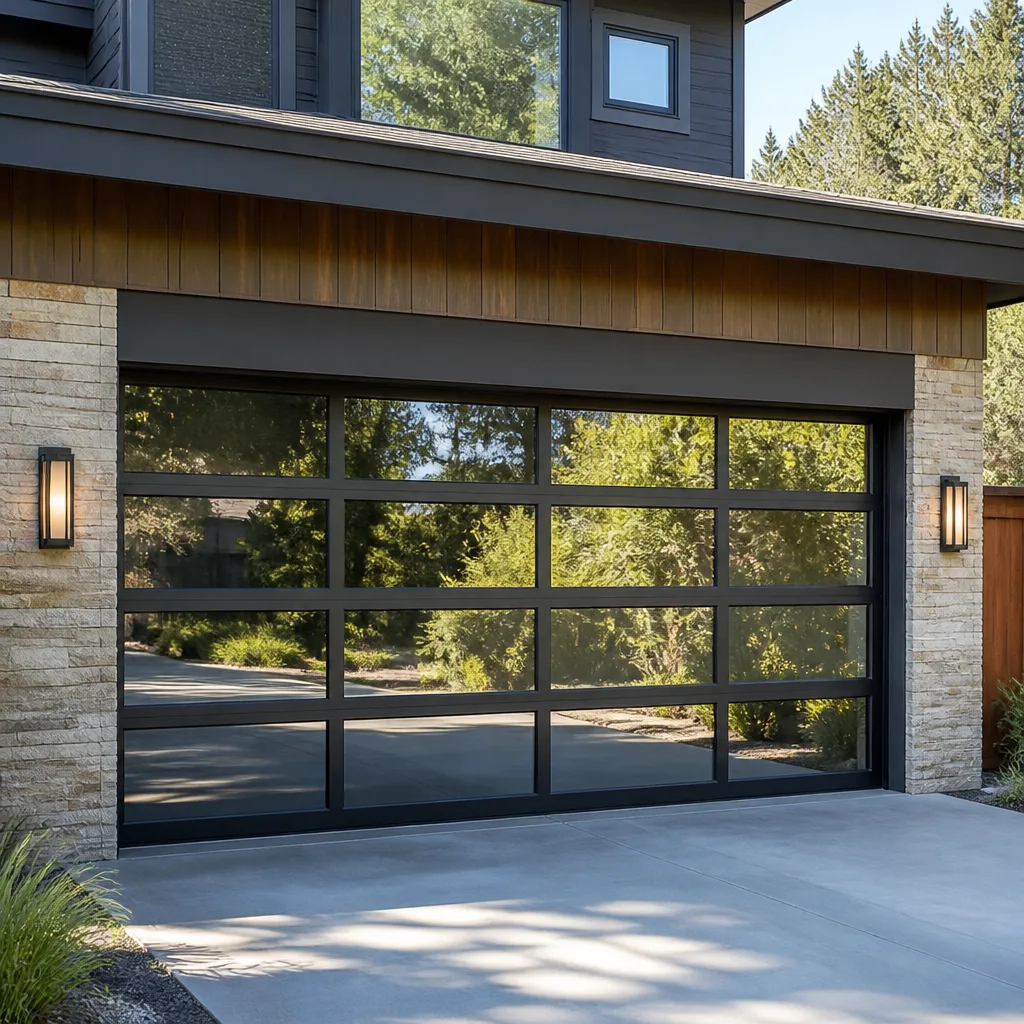 Full-view glass
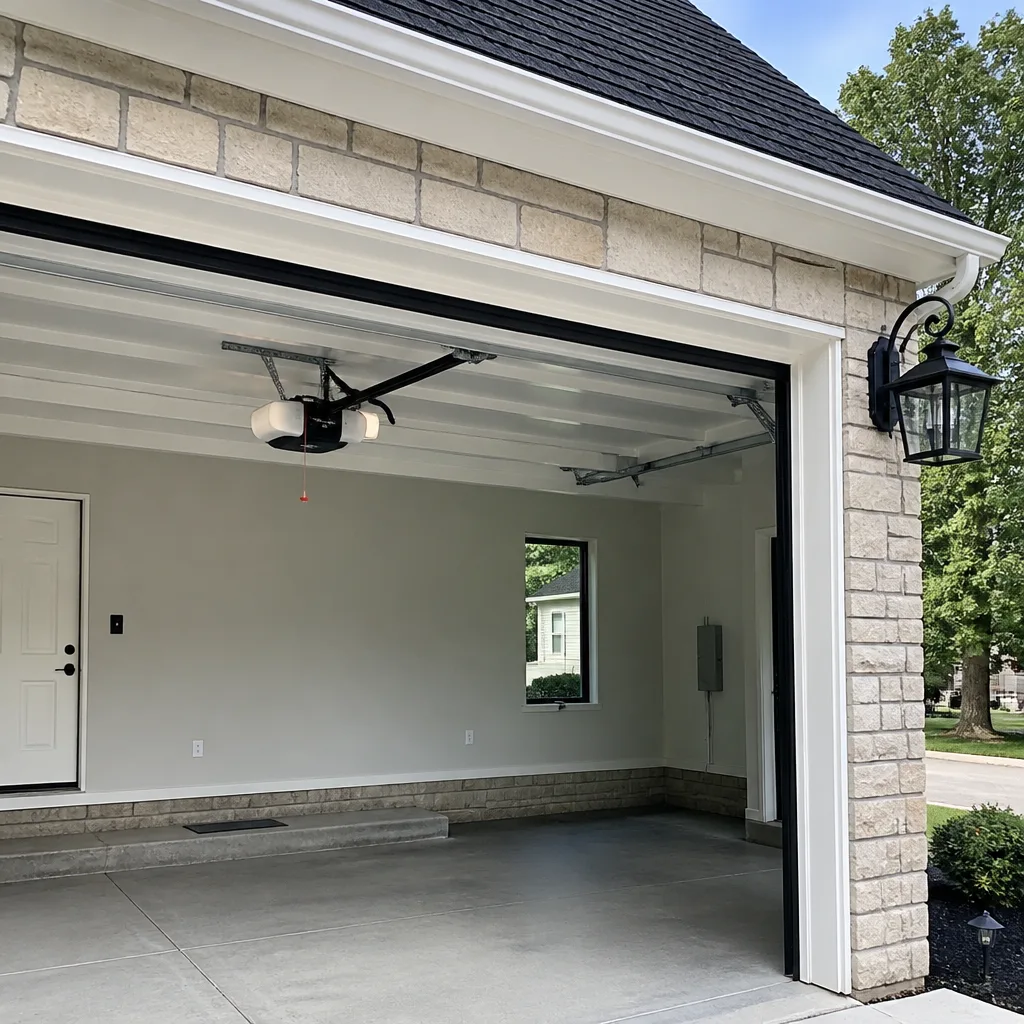 LiftMaster openers
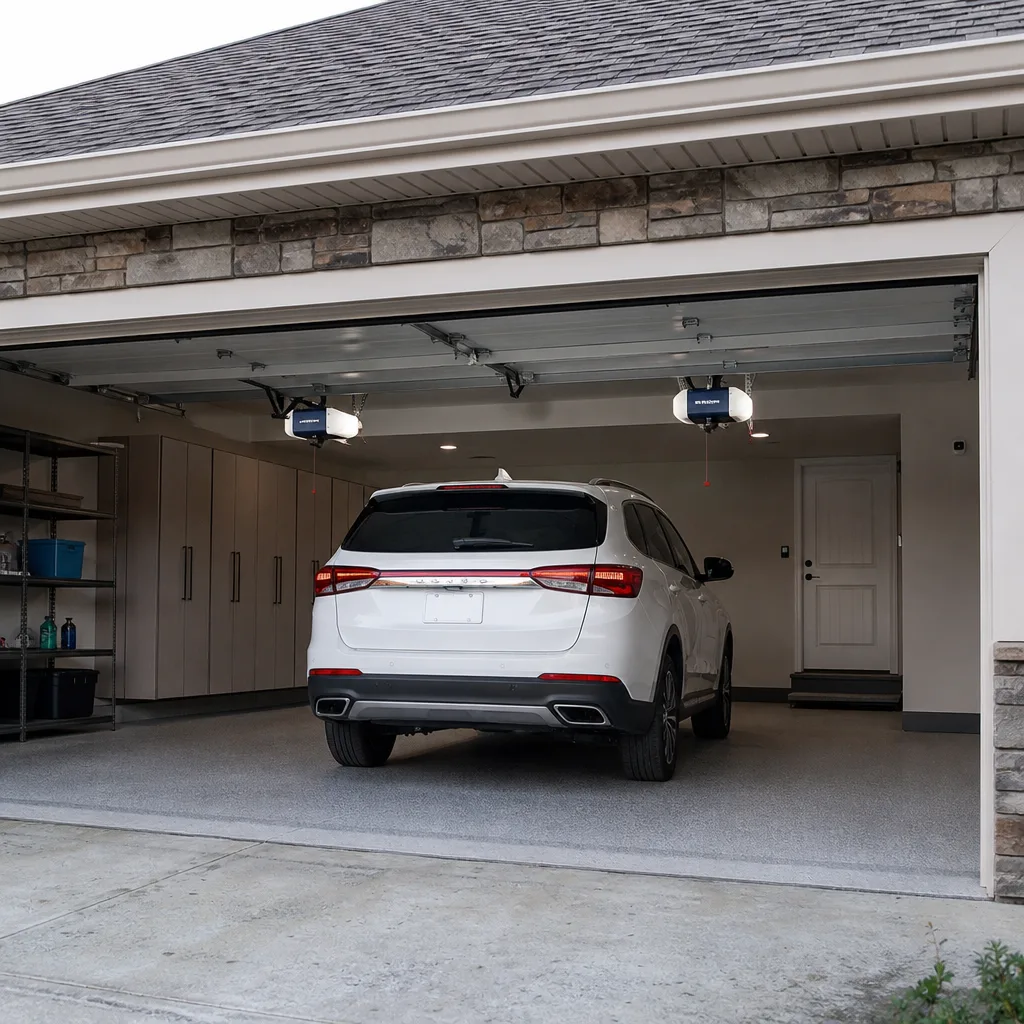 Chamberlain openers
Full 25-point door and opener safety check with every visit - springs, cables, rollers, tracks, and your LiftMaster or Chamberlain opener included
You get a price before we start. It does not change when the truck arrives.
Get your free estimateGarage Door Repair Maintenance Checklist for Fort Lauderdale Homeowners
The number-one cause of torsion spring failure in coastal South Florida is not age. It’s salt-air oxidation eating through the coil from the inside out. By the time you see rust on the outside of a spring in Fort Lauderdale, the internal damage is often already done, and no standard maintenance checklist tells you how to spot it early. This guide changes that. You’ll learn the month-by-month schedule that matches Fort Lauderdale’s actual calendar, which lubricants survive our humidity, and the three corrosion points that fail first in a salt-air climate.
Styles & brands we work with
Quick Answer
A Fort Lauderdale garage door maintenance checklist should run on a two-season rhythm: corrosion control and lubrication adjustments from November through April, and hurricane-hardening plus track inspection from May through October. The five tasks that matter most are lubricating moving parts with a lithium-based grease, testing the auto-reverse sensors monthly, inspecting the bottom bracket and cable drum for rust every 60 days, tightening all hinge and track bolts each quarter, and running a full pre-hurricane inspection every May. Most homeowners can handle all of this in under 90 minutes per season without touching a single high-tension component, though for anything beyond your comfort level, our Garage Door Repair team is available.
Table of Contents
- Fort Lauderdale’s Two-Season Maintenance Calendar
- What to Lubricate and What to Use in a Humid Coastal Climate
- The Three Corrosion Points Salt Air Attacks First
- The Five-Minute Safety Tests Every Homeowner Should Run
- Hurricane Season Prep: A Fort Lauderdale-Specific Protocol
- What You Can Safely Do Yourself and What You Should Never Touch
- How to Keep a Maintenance Log That Satisfies Insurance and Buyers
- Common Mistakes to Avoid
- When to Call a Professional
- Frequently Asked Questions
- The Bottom Line
Fort Lauderdale’s Two-Season Maintenance Calendar
Fort Lauderdale does not have four seasons. We have two: the dry season, running roughly November through April, and the wet season, running May through October. Your garage door does not care about the names on a New England calendar. It cares about humidity, salt, wind, and temperature swings. Here is the maintenance rhythm we recommend to homeowners across the city, from Victoria Park to Coral Ridge to Riverland.
Dry Season: November through April
The dry season is your repair season. The air holds less moisture, metals stay drier, and lubricants last longer. This is the window for deep maintenance work.
- November: Post-hurricane inspection. Walk the full track line, check for storm damage, clean debris from the bottom weather seal, and test the door’s balance by disengaging the opener and lifting the door manually to waist height. If it stays put, the springs are doing their job. If it falls or rises, the springs are worn and need attention.
- December: Lubricate all moving parts with a lithium-based grease (more on this below). Tighten every bolt on the hinges, track brackets, and opener mounting plate.
- January: Test the auto-reverse sensors and the manual release handle. Dry air means less swelling on the wooden door frames in older Fort Lauderdale homes, so this is the month to check for binding along the track.
- February: Apply a thin corrosion inhibitor to the cable drums, bottom brackets, and roller stems. This is the month when salt from the winter winds has accumulated and the dry air lets you see it clearly.
- March: Clean the photo-eye lenses with a dry microfiber cloth. Humidity is still low, so any adjustment you make to the sensor alignment will hold through the first weeks of the wet season.
- April: Final pre-hurricane parts order. Order any replacement rollers, hinges, or weather seals now. Waiting until June means supply chain delays right when you need the parts.
Wet Season: May through October
The wet season is your survival season. The average afternoon thunderstorm in Fort Lauderdale drops more water in 30 minutes than most cities see in a week. Salt air, high heat, and daily moisture create ideal conditions for corrosion. Your job now is to watch, tighten, and spot problems before they become breakdowns.
- May: Full hurricane-hardening protocol (detailed in its own section below). Tighten all track brackets, inspect the reinforcing struts if your door has them, and verify the hurricane bracing meets current Broward County code.
- June: Test the auto-reverse sensors weekly. Lightning strikes and heavy rain knock sensors out of alignment more often in June than any other month in Fort Lauderdale.
- July: Lubricate lightly at mid-season. The humidity degrades even the best lubricants faster here. A light reapplication on the rollers and hinges mid-summer can carry you through August.
- August: Inspect the bottom weather seal for mildew or warping. Standing water and daily thermal expansion break down rubber seals fast. A failed seal lets in water, rodents, and hot air.
- September: Re-check all bolts and brackets. September is peak hurricane month in South Florida, and the constant wind flex on the door works bolts loose. A loose track bracket in September is a door off the track in October.
- October: End-of-season deep clean. Remove salt residue from all accessible metal surfaces with a damp cloth, dry thoroughly, and reapply corrosion inhibitor. This prevents the dry-season rust bloom that catches so many Fort Lauderdale homeowners off guard in November.
If this feels like a lot, remember: most of these tasks take under ten minutes. The total annual time investment is about six hours, and it typically prevents the two repair calls Fort Lauderdale homeowners make most often: spring replacements and door-off-track incidents after storms.
For a full breakdown of what repairs actually cost in this market, see our guide to Garage Door Repair in Fort Lauderdale.
What to Lubricate and What to Use in a Humid Coastal Climate
Every generic garage door maintenance article says “lubricate the moving parts.” Almost none of them tell you what to use, and that omission causes real damage in Fort Lauderdale. The wrong lubricant in our climate attracts dust and sand, traps moisture, and accelerates the exact corrosion you are trying to prevent.
What to Use
Use a white lithium grease or a purpose-made garage door lubricant (sprayable, non-silicone). Lithium grease stays in place, resists washout from humidity, and does not become gummy in the heat. For rollers with ball bearings, a light machine oil works well. For the springs themselves, use a spray lithium grease that can penetrate between the coils.
Why WD-40 Is the Wrong Answer
WD-40 is a water displacement formula, not a lubricant. It works by penetrating and loosening rust, which is useful for freeing a stuck bolt, but it evaporates within days and leaves behind a thin film that actually attracts dust. In a coastal climate like Fort Lauderdale’s, that film collects salt and sand. Within weeks, the area you sprayed is worse than it was before. Every professional garage door technician in South Florida has repaired doors where a homeowner “maintained” the springs with WD-40 for years and then wondered why the coils rusted from the inside.
What to Lubricate, Specifically
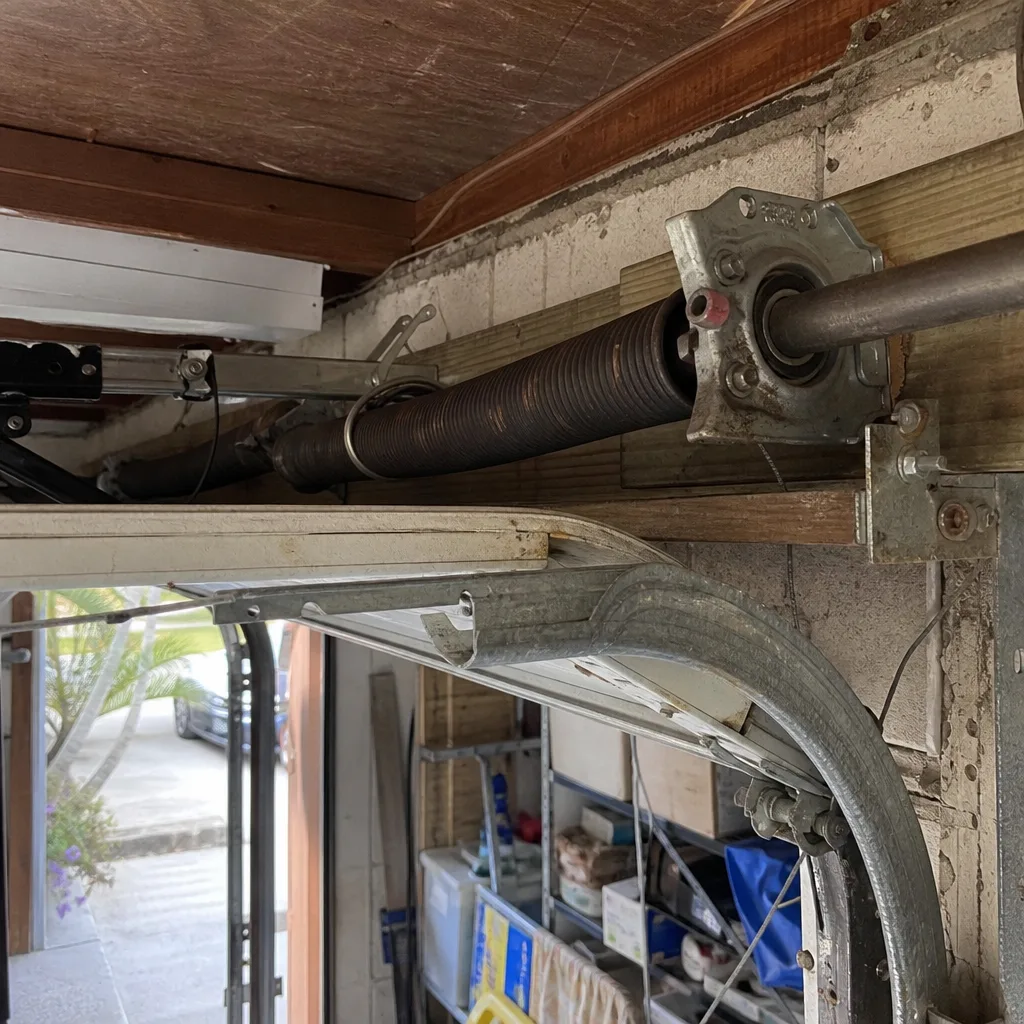
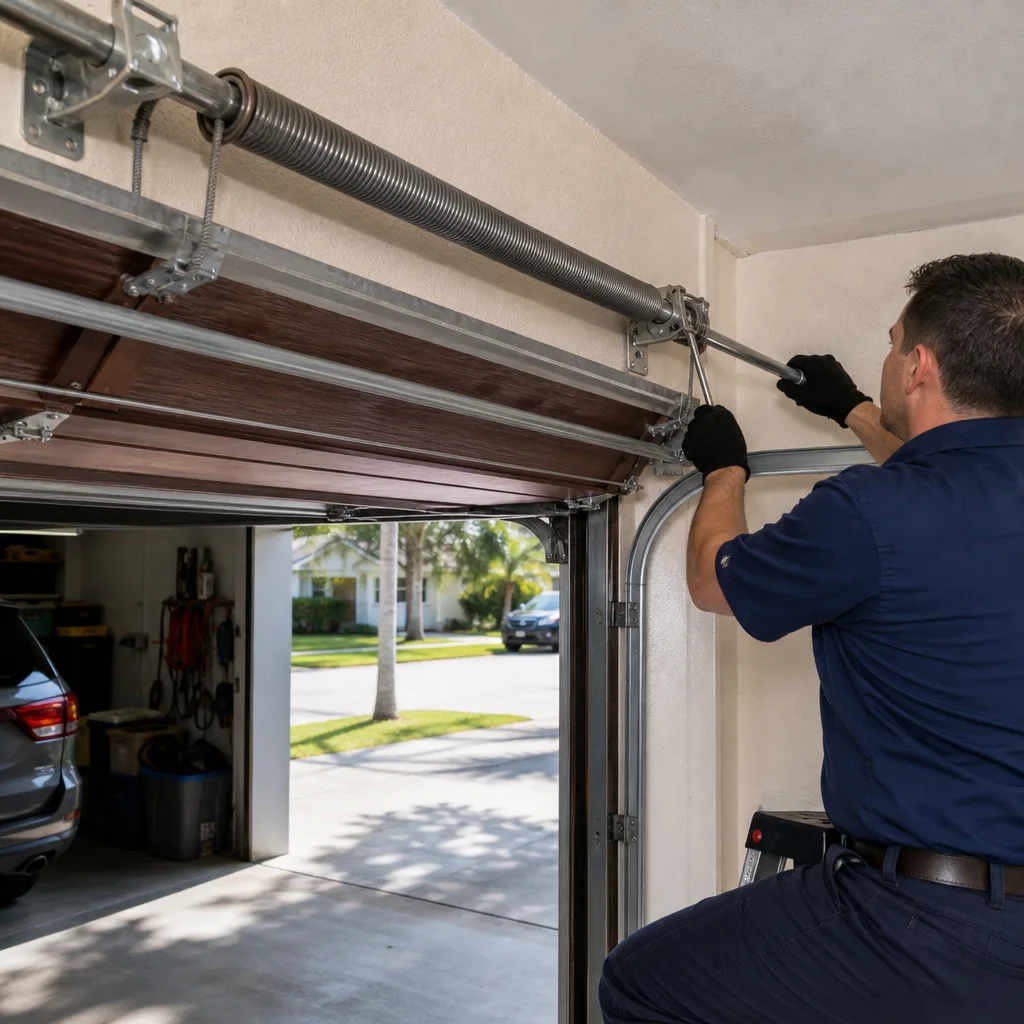
- Torsion spring (the heavy coil mounted above the door that handles most of the lifting weight): spray the full length lightly. Do not soak it. Excess lubricant drips onto the door and attracts sand.
- Extension springs (the side-mounted springs on older doors): lubricate the coils and the pulley wheels they travel over. These are more common on older homes in neighborhoods like Riverside Park and Sailboat Bend.
- Rollers: if they have ball bearings, one drop of light oil per bearing. If they are nylon with no exposed bearing, spray the stem only, not the wheel, to keep the lubricant off the surface that contacts the track.
- Hinges: spray the pivot point where the two hinge halves meet. Do not lubricate the flat face of the hinge.
- Track: do not lubricate the inside of the track. The rollers need friction against the track to roll rather than slide. Lubricating the track is one of the most common maintenance mistakes we see across Fort Lauderdale, and it causes the door to slip and jerk.
- Lift cable: never lubricate the cable. The cable needs to grip the drum. Lubricating it causes slippage and uneven spooling.
The rule is simple: if it rolls, lubricate the bearing or pivot. If it slides, leave it dry. If you are not sure which category a part falls into, ask during your next service visit. Most Fort Lauderdale homeowners find that a five-minute lubrication session every three to four months keeps every moving part quiet and smooth.
The Three Corrosion Points Salt Air Attacks First
Salt air does not attack a garage door evenly. It concentrates on three specific points, and if you inspect these three spots every 60 days, you will catch 90 percent of corrosion-related failures before they happen. The good news is that all three inspections are visual only. You do not need to touch anything under tension.
1. The Bottom Bracket
The bottom bracket holds the lift cable and is attached to the bottom of the door. It sits closest to the ground, which means it is in the splash zone every time rain hits your driveway. In Fort Lauderdale, the bottom bracket sees more water than any other metal component on the door. Look for chalky white or green residue, which indicates oxidation. If the bracket is rusted through or shows hairline cracks, it needs replacement. A failed bottom bracket will drop a tensioned cable that can cause serious injury. Do not attempt this repair yourself. This is a Garage Door Spring Repair in Fort Lauderdale call, and any reputable company will handle the bracket replacement as part of the job.
2. The Cable Drum
The cable drum is the grooved metal wheel at each end of the torsion tube, above the door opening. The lift cable wraps around it. Over time, salt air etches the groove surface, which then abrades the cable every time the door opens. What starts as a hairline scratch on the drum becomes a frayed cable, and a frayed cable can snap. Inspect the drum faces for rust blooms and the grooves for rough edges. If you see either, schedule a professional inspection. The cable is under tension even when the door is closed.
3. The Roller Stems
The roller stem is the metal shaft that connects the roller wheel to the hinge. On Fort Lauderdale doors exposed to sea breeze, the stems rust before the wheels or hinges do. A rust-weakened stem bends under load, which pulls the roller out of alignment with the track. That misalignment is the leading cause of doors jumping the track during high-wind events. Check the stems where they disappear into the roller wheel. If you see rust flaking or pitting, the roller assembly needs replacement. This is a job an experienced Fort Lauderdale homeowner can do on the bottom rollers (the top rollers are under cable tension), but it requires removing the hinge bolt and re-hanging the roller, and getting it wrong makes the door bind.
In our experience across Fort Lauderdale, homes within two miles of the Intracoastal see these three parts rust at roughly twice the rate of homes further west. If you live east of US-1, we recommend the 60-day inspection cycle. West of I-95, a 90-day cycle is usually sufficient. Use that as your personal rule based on where you are in the city.
The Five-Minute Safety Tests Every Homeowner Should Run
These three tests take under five minutes combined and require no tools. Run them monthly. They are the single most valuable maintenance task you can do, and almost no Fort Lauderdale homeowner does them consistently until after a close call.
Test 1: Auto-Reverse Sensor Test (Two Minutes)
The auto-reverse sensors are the two small plastic units mounted on the door track, about six inches off the ground. They project an invisible beam across the door opening. If anything breaks the beam while the door is closing, the opener should reverse immediately. To test: place a full cardboard box or a two-by-four flat on the ground in the door’s path, then close the door using the wall button or remote. The door should touch the object and reverse direction within two seconds. If it does not reverse, the sensors may be misaligned, dirty, or faulty. Clean the lenses with a dry cloth and re-test. If it still fails, keep the door disconnected from the opener until a professional can check it. This is the test that prevents the most common and most severe garage door injury: a door closing on a child or pet.
Test 2: Manual Release and Balance Test (Two Minutes)
Pull the red emergency release cord hanging from the opener rail. This disconnects the door from the opener. Then lift the door manually to waist height and let go. A healthy door stays in place. If it drops, the springs are under-tensioned and doing less work than they were designed for, which means the opener is carrying extra load and will fail early. If it rises on its own, the springs are over-tensioned, which is less common but equally hard on the opener. Both conditions mean the spring system needs professional adjustment. Reconnect the opener by running it until it re-engages.
Test 3: Limit Switch Travel Test (One Minute)
The limit switch controls how far the door travels before the opener stops. A correctly set limit switch leaves the door fully closed without pressing into the floor, and fully open without slamming the opener rail. Run a full open and close cycle. Watch for these signs: the door reverses right after touching the floor at the bottom, the door strains or reverses near the top, or the opener runs for a beat after the door stops. Any of these means the limit switch needs adjustment. This is a five-minute job for a technician, and it is included in most service calls. A misadjusted limit switch is the most common cause of opener motor burnout we see in Fort Lauderdale, because the motor keeps working after the door has already stopped.
Run these three tests on the first weekend of every month. Ten minutes total. That is the entire commitment, and it catches the three failure modes that account for the majority of emergency service calls in this city.
Need a deeper read on the repair side? Our Bramwell Garage Doors Fort Lauderdale home page walks through the full service menu.
Hurricane Season Prep: A Fort Lauderdale-Specific Protocol
Every garage door in Fort Lauderdale is a wind-rated component of the home’s structural envelope. After Hurricane Andrew, Broward County updated its building codes to require wind-rated garage doors on new construction and major remodels. But wind-rated does not mean maintenance-free. A wind-rated door with loose track brackets, worn rollers, and a failing bottom seal offers about as much protection as a screen door.
Here is our pre-hurricane protocol. Run it in late May, before the season starts in earnest.
- Inspect and tighten every track bracket. The vertical and horizontal track brackets are what hold the door in place during wind loading. A loose bracket allows the track to flex, and a flexing track lets the rollers pop out. Check every bracket with a socket wrench. If you can turn the bolt by hand, it needs tightening.
- Check the reinforcing struts. If your door has horizontal metal struts across each panel, verify that every strut bolt is tight and that the struts are straight. A bent strut means the door has already taken a wind hit and its structural capacity is reduced.
- Replace a failing bottom weather seal. The rubber strip at the bottom of the door keeps water and debris out. In a hurricane, it also prevents wind-driven rain from pressurizing the garage. A torn or brittle seal allows water in at the exact moment you can least afford it. Replacement seals cost about $30 and take an hour to install on most doors.
- Verify your opener’s battery backup (if equipped). Power outages are almost guaranteed in a Fort Lauderdale hurricane. A battery-backup opener lets you open the door after the storm passes, so you are not trapped in the garage or locked out of it. Test the battery by unplugging the opener and running a cycle. If the battery is more than two years old, replace it before the season starts.
- Document everything. Photograph the door, the track, the brackets, and the opener from multiple angles. Store the photos in your insurance folder. A pre-season photo record is the single most useful piece of evidence in a post-storm claim.
If your door is older than 20 years, or if it was installed before 2002 when the current wind-rating codes took effect, consider a professional wind-load inspection. The cost of an inspection is a fraction of what an under-rated door failure costs when a Category 2 or higher storm pushes through the city.
What You Can Safely Do Yourself and What You Should Never Touch
Garage doors are deceptive. Most of the door’s weight is counterbalanced by the spring system, which means the door feels light and easy to move. That lightness hides the fact that the spring system is storing thousands of pounds of tension. If a spring lets go while you are working on it, it will not be a minor injury. It will be a catastrophic one.
Here is the honest line between what a homeowner can handle and what requires a trained professional.
Safe for Homeowners
- Visual inspections of all hardware
- Tightening accessible bolts on hinges and track brackets
- Lubricating springs, hinges, and roller bearings
- Testing the auto-reverse sensors and manual release
- Replacing the bottom weather seal
- Cleaning the photo-eye lenses
- Adjusting the opener’s force and travel settings (consult your opener manual first)
- Replacing remote batteries and reprogramming keypads
Professional Only, No Exceptions
- Torsion spring replacement or adjustment (the spring above the door)
- Extension spring replacement or adjustment (the springs along the sides)
- Lift cable replacement or re-spooling
- Track removal, replacement, or re-alignment requiring release of tension
- Bottom bracket replacement (the cable is attached to it)
- Opener motor replacement or any work involving the opener’s internal gears and circuit board
The rule that has served Fort Lauderdale homeowners best is simple: if the part is connected to a spring or a cable, do not touch it. The tension involved is invisible, and the consequences of a mistake are immediate and severe. Every reputable garage door company follows this same rule for their own technicians, who undergo specific training before they are cleared to work on tensioned systems.
If you are weighing a full replacement rather than another repair, see Garage Door Installation in Fort Lauderdale for what to expect on timing, materials, and price in our market.
How to Keep a Maintenance Log That Satisfies Insurance and Buyers
Here is a truth most homeowners in Fort Lauderdale learn the hard way: a maintenance log is not for you. It is for the two institutions that will eventually ask for proof that you maintained the garage door. The first is your homeowner’s insurance company, after a storm claim. The second is a buyer’s home inspector, when you sell the house. Both parties accept the same evidence, and both are looking for the same thing: a consistent, dated record of real maintenance work.
What to Log
- Date and type of each maintenance task performed (lubrication, inspection, sensor test, seal replacement).
- Products used, including brand and type. “Lithium grease, spray, 3-IN-ONE” is sufficient.
- Observations. “Surface rust on bottom bracket, East side. Will monitor.” Or “Roller stems clean, no pitting.”
- Any professional service visits, including the company name, date, work performed, and the written guarantee period.
- Pre-season photographs, dated and stored with the log.
Format
A simple spiral notebook kept in the garage works. A spreadsheet does too. The format matters less than the consistency. What insurance adjusters and inspectors look for is a pattern. A single entry from three years ago suggests you logged one task once. Eighteen entries spread across four years tells the story of a homeowner who maintained the door. That story is what gets a claim approved or a sale to closing.
Keep the log near the door, paired with a pen. The friction of finding it later is why most logs die after two entries. Taped inside a cabinet door or hung from a hook beside the opener is the right spot.
Common Mistakes to Avoid
- Using WD-40 as a lubricant. It is a solvent and water displacer, not a lubricant. In Fort Lauderdale’s humid, salty air, it leaves behind a film that attracts exactly the sand and salt you are trying to keep off the hardware.
- Lubricating the track. The rollers need friction against the track to roll. A greasy track causes the door to slide, jerking through the travel and wearing both the rollers and the opener.
- Skipping the May pre-hurricane inspection. Every year, Fort Lauderdale homeowners lose doors to storms that would have held fine if the track brackets had been tightened and the struts inspected. Twenty minutes in May prevents most of these failures.
- Ignoring a slow or jerky door because it still opens. A door that hesitates, shudders, or scrapes is telling you something is failing. Waiting until it stops completely turns a $150 hinge replacement into a $400 off-track repair and service call.
- Testing the auto-reverse sensors by waving a hand in the beam. That tests the photo eye, but not the door’s reversal under load. The two-by-four test is the only one that matters, because it replicates the weight of a child or a pet.
- Documenting repairs verbally. “The guy said it was fixed and guaranteed” is not documentation. A written guarantee with a date, scope, and company name is. Every home sale in Fort Lauderdale goes smoother when the seller can produce real repair records.
- Tightening a loose bolt on a bracket while the door is in the open position. The weight distribution changes as the door moves, and you risk cross-threading or stripping the bolt. Lower the door first, then tighten.
When to Call a Professional
Call a professional the moment you notice any of these: a snapping or popping sound from the spring area, a frayed or kinked lift cable, a door that will not stay in place when manually lifted to waist height, a bottom bracket with visible rust blooms or cracks, or a door that reverses immediately after touching the floor. Each of these indicates a tension-system problem, and that is not a do-it-yourself category under any circumstances. A snapped spring or cable under load can cause serious injury in a fraction of a second.
For more guides & resources like this one, visit our blog. Bramwell Garage Doors Fort Lauderdale offers free estimates throughout Fort Lauderdale and the surrounding neighborhoods. Call (754) 701-2440 and a live person answers, day or night. You’ll get a written price before any work begins, and your repair is covered by the 365-Day Done Right Promise in writing.
Frequently Asked Questions
Every three to four months during the wet season (May through October), and every six months during the dry season (November through April). The humidity and salt air in Fort Lauderdale degrade lubricants faster than in inland climates, and a lithium-based grease reapplication at these intervals keeps springs, hinges, and roller bearings protected year-round. Call (754) 701-2440 and we’ll walk you through exactly what to use on your specific door.
Professional garage door maintenance visits in Fort Lauderdale typically run $89 to $139 for an inspection and lubrication service, or $59 to $89 when bundled with a repair or spring replacement. Most spring replacements run $150 to $280 for torsion springs and $120 to $220 for extension springs, parts and labor included. These are the ranges we quote upfront before any work begins in Fort Lauderdale, so the number you hear is the number on the invoice.
Yes, for the visual inspections, bolt tightening, lubrication, sensor tests, and weather seal replacement covered in this guide. No, for any work on springs, cables, bottom brackets, or track re-alignment. Those systems are under tension, and the risk of serious injury is real. We recommend homeowners handle the maintenance calendar themselves and call a professional for anything involving tensioned hardware.
A spring is failing when the door will not stay in place when manually lifted to waist height, when you hear popping or creaking sounds from the spring area during operation, or when you see visible gaps between the coils of a torsion spring. In Fort Lauderdale, we also look for rust staining on the spring coils, which indicates salt-air oxidation has already compromised the metal internally. If you see any of these, it is time for a spring inspection.
Most torsion spring replacements in Fort Lauderdale run $150 to $280, parts and labor included, and most extension spring replacements run $120 to $220. These are the prices Bramwell Garage Doors Fort Lauderdale quotes in writing before work starts. The 365-Day Done Right Promise means if the repair fails within a year, we come back and fix it at no charge. Call (754) 701-2440 for an exact quote on your door.
The wind rating itself is established at the time of manufacture and installation, but the rating assumes the door is properly maintained. Loose track brackets, worn rollers, and failed bottom seals all reduce the door’s actual wind performance below its rated capacity. For homeowners east of US-1 in Fort Lauderdale, we recommend a professional wind-load inspection every two years, plus the pre-hurricane protocol in this guide every May.
The Bottom Line
Fort Lauderdale garage doors live harder lives than doors almost anywhere else in the country. Salt air, daily humidity, and hurricane-season wind all work against the metal and moving parts year-round. The maintenance calendar in this guide, run consistently, adds years to your springs, prevents most emergency repairs, and keeps the door doing its job as a structural component of the house. Visit our Bramwell Garage Doors Fort Lauderdale home page for the full service range, or call (754) 701-2440 to schedule a free estimate. A live person answers, and every repair comes with a written price before work starts and the 365-Day Done Right Promise in writing.
Written by Marcus Ellery, Owner at Bramwell Garage Doors Fort Lauderdale, serving Fort Lauderdale since 2001.
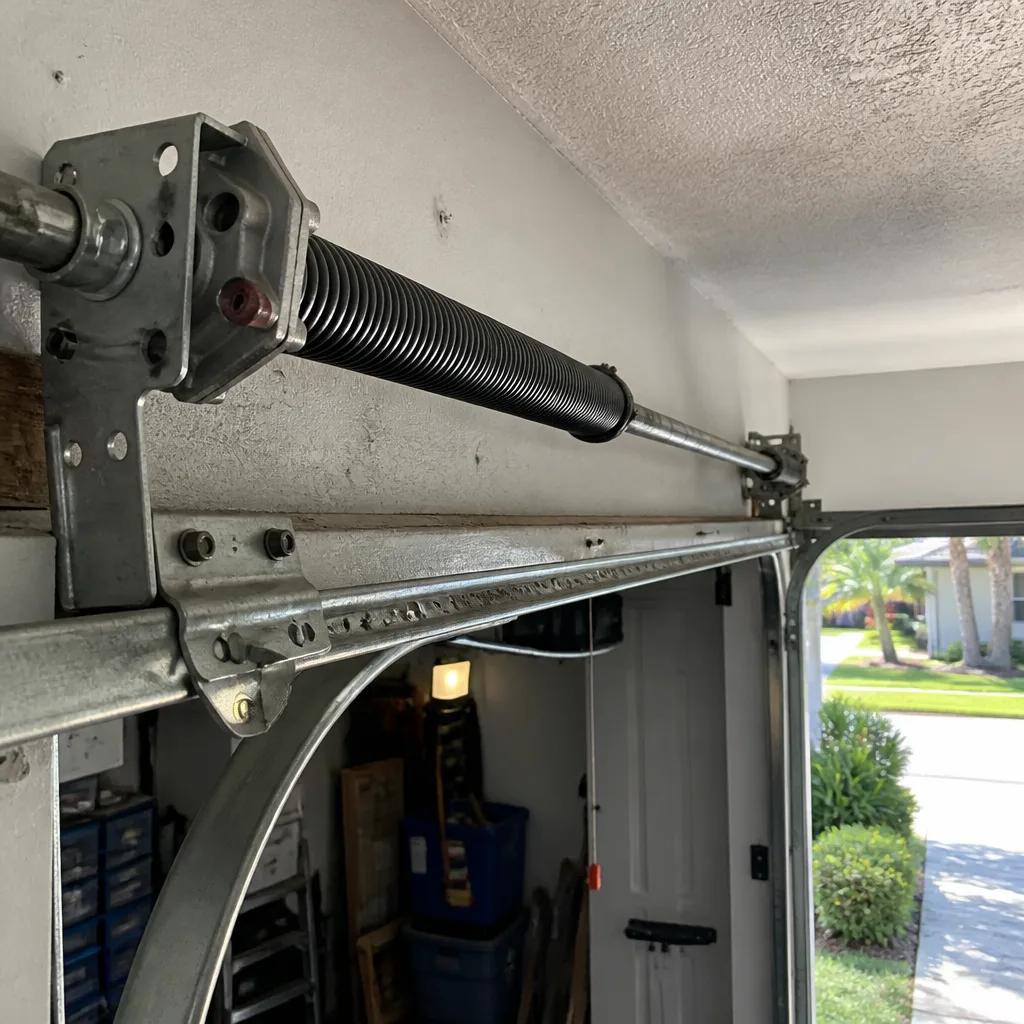
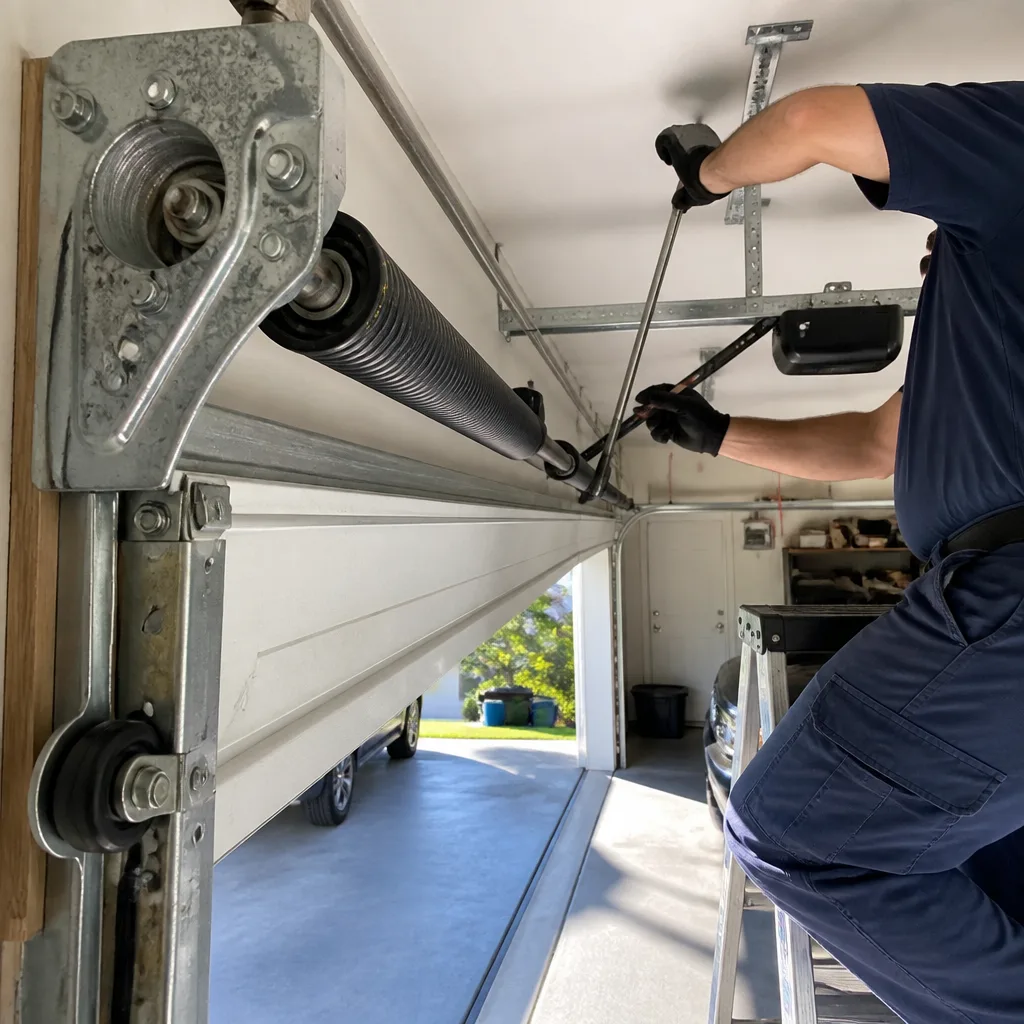
See the difference
 Before
 After
After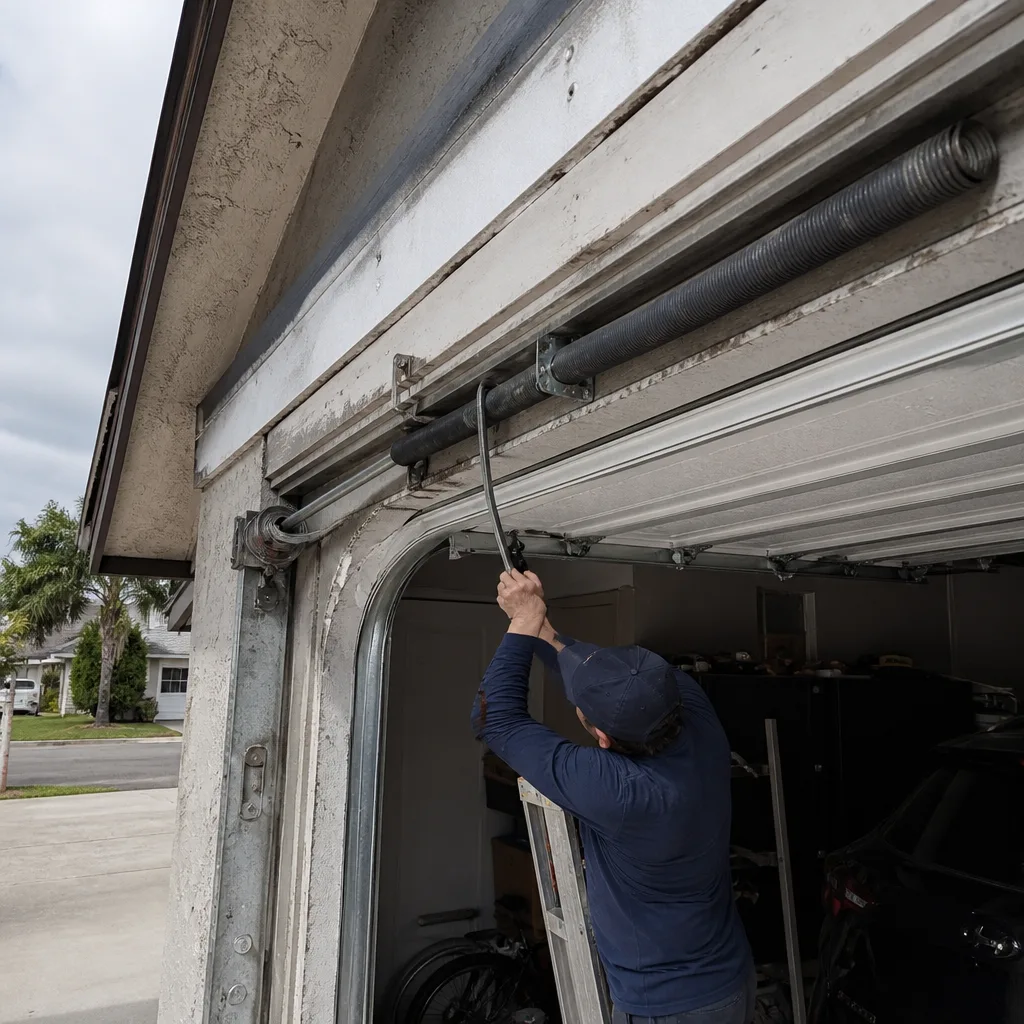 Before
 After
After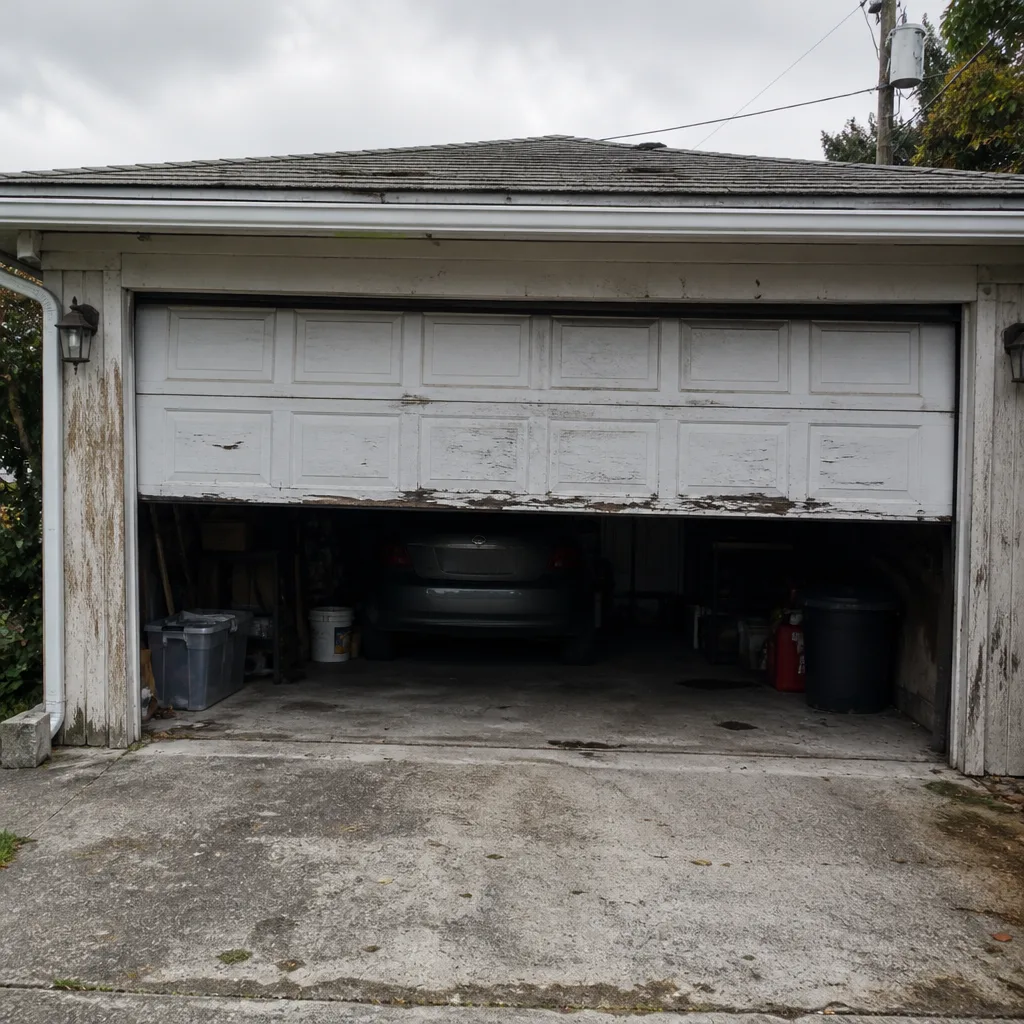 Before
 After
After